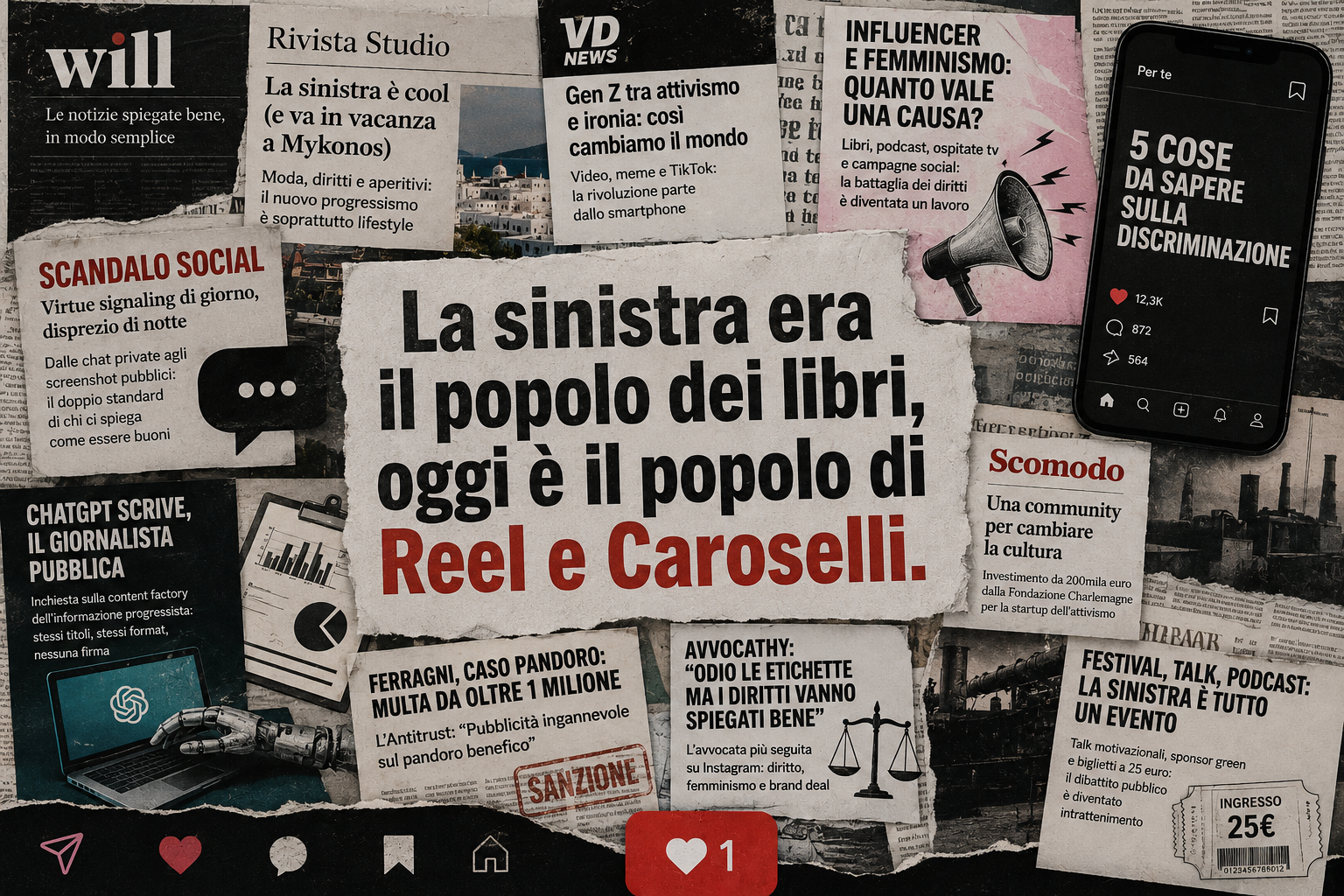
It isn't true that the contemporary left "no longer speaks to anyone."
It speaks constantly.
The problem is that almost all of this communication produces no organization, no collective consciousness, no social conflict and no material transformation.
It produces audience, individual reputation, professional opportunities, advertising campaigns and communities of culturally homogeneous consumers.
The twentieth-century left had parties, unions, local branches, cooperatives, people's houses, cultural circles, newspapers, theoretical journals, political schools and popular organizations. Of course it was riddled with hierarchies, dogmatisms and enormous mistakes, but it had one ambition: to educate people and win collective power.
The new digital progressive-woke-performative sphere, by contrast, has an enormous capacity for representation and a very poor capacity for concreteness and social transformation.
It can explain in sixty seconds why a word is problematic, but it can't organize a neighborhood; it can produce a podcast about precarious work, but it rarely questions the economic system that funds the podcast; it speaks in the name of minorities, young people, workers and the periphery, but it is often made up of urban professionals competing for publishing contracts, consultancies, corporate partnerships and visibility.
It isn't simply "a dumber left."
It's a left subjected to a different system of incentives.
Algorithms reward recognizability, simplification, antagonism, emotion and posting consistency, not depth or political coherence. Recent research on platform logic shows, for example, that some digital environments reward antagonism and toxicity more than respect and nuance; other studies have documented the formation of separate communities, in which users mostly consume content that aligns with their own beliefs.
The perfect leader for the social media era
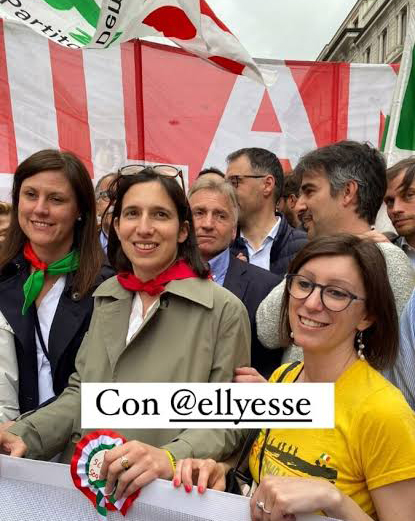
Elly Schlein probably represents the high point of the aesthetic transformation of the Italian left.
She's young, communicates perfectly on social media, belongs to the LGBTQ+ community, speaks the language of the new generations and has become, even symbolically, the face of a new progressive season.
And yet this is exactly where one of the biggest contradictions of the contemporary left emerges. While most of her communication revolves around "leftist" identity and aesthetics, on the big geopolitical questions the Democratic Party keeps voting like Giorgia Meloni.
On military support for Ukraine and European rearmament, on the increase in defense spending and, on several occasions, on the major choices of foreign policy, the distance from the "fascist government" has been far less radical than the PD's political communication would have you believe.
This is the paradox of the algorithm's left: the faces change, the graphics change, the reels and carousels change, but when it comes to the decisions that actually determine the international balance of power, the margin of conflict with the establishment never arrives.
Under Schlein's leadership, the communication gives the impression of a "feminist and LGBTQI+" revolution. The real politics far more often gives back an impression of systemic continuity with far-right policies.
The platforms of corporate progressive media (there are thousands, I'll just take a few useful examples).
Will Media presents itself as a guiding voice for Millennials and Gen Z and claims millions of followers across its platforms. Since 2022 it has been joined with Chora Media in a digital publishing hub that also produces projects backed by companies and associations; alongside editorial content it offers memberships, events and community activities.
This doesn't prove that WILL's content is false or worthless. The critical point is a different one: can an entity that lives structurally inside the economy of corporations, partnerships and personal branding build a radical critique of the system that sustains it?
The result is often a pedagogical, compatible progressivism, which describes the problems of capitalism as a collection of innovations, individual behaviors, best practices and opportunities for participation.
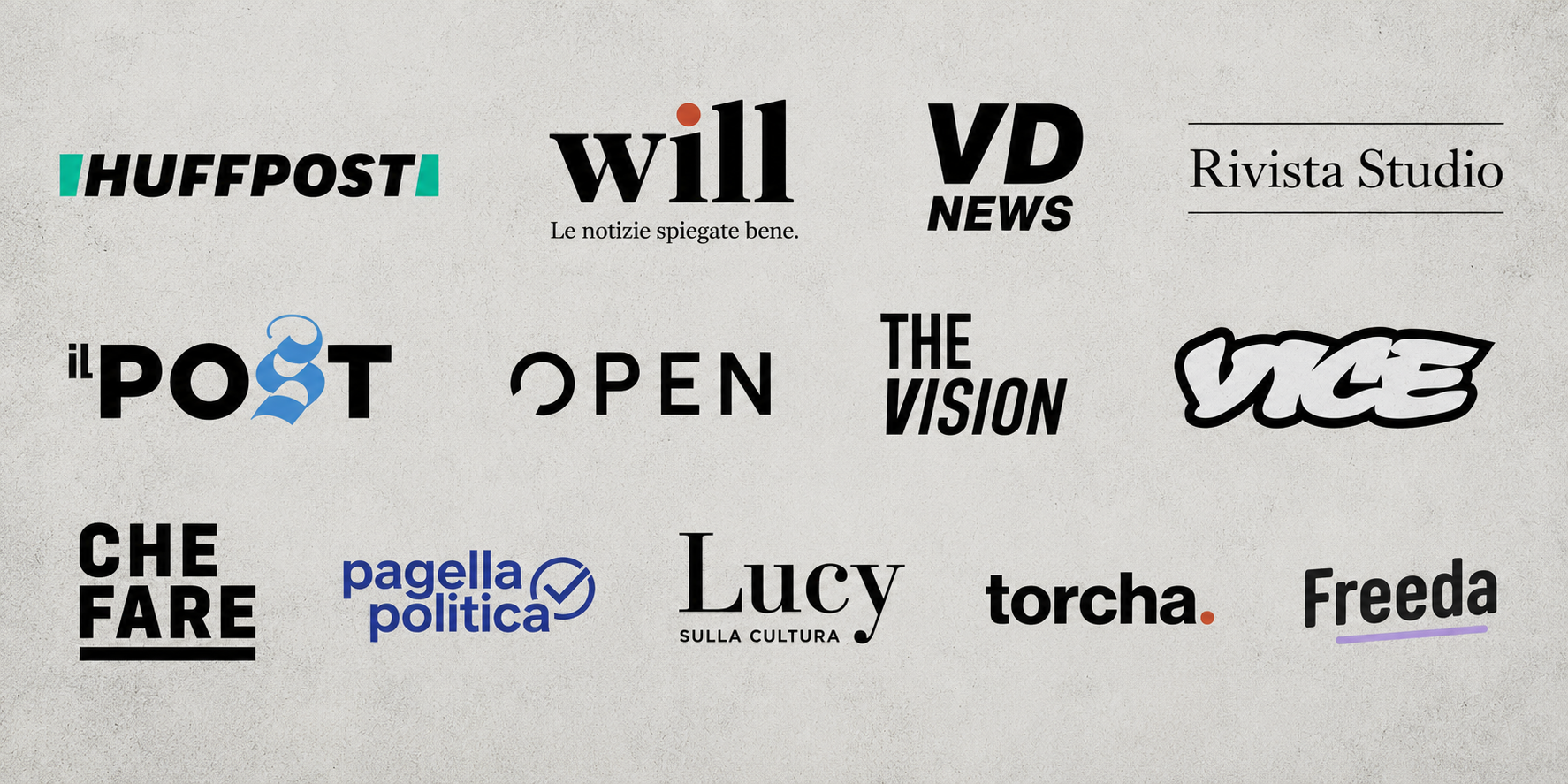
VD News describes itself as a news and entertainment outlet, but also as a production house that develops commercial and editorial content for companies. Here too, the problem isn't the existence of advertising, which is common to most media, but the growing indistinguishability between news, entertainment, moral positioning and commercial communication.
Rivista Studio belongs to Most Media Group alongside Undici and openly positions itself at the crossroads of current affairs, culture, lifestyle and fashion. It isn't a pedagogical platform for young people, but it represents well the transformation of culture into lifestyle and trend. Politics enters it often as an aesthetic or generational phenomenon, rather than as a material clash between opposing interests and classes.
Scomodo was founded in 2016 declaring a will for social and cultural change, has built physical communities in several cities and continues to claim a territorial dimension, not just a digital one.
At the same time, the project has become a "community company," has launched equity crowdfunding and in 2025 received an investment of 200,000 euros from the Fondazione Charlemagne.
This is a more interesting contradiction than simply "being Christian Democrats": what happens when an entity born to build cultural autonomy has to turn participation, community and sociality into an economically scalable model? Scomodo could become the case study of the passage from collective to community startup, without denying what it has actually built on the ground.
"They are not political organizations that use the language of the media. They are media companies that use the language of politics."
Artificial intelligence didn't create the sterility of this kind of journalism. It arrived when a large part of the content was already written as if it had been produced by a machine: interchangeable headlines, predictable structures, a falsely informal or alarming tone, three facts taken from elsewhere, one concluding moral sentence and no direct experience of the concrete world. AI hasn't replaced journalists; it has revealed how much content never actually needed an intellectual.
Rights influencers and virtual militancy (there are thousands, I'll take a few useful examples).
Cathy La Torre, for example, is a lawyer specializing in anti-discrimination law, has taken part in founding associations and legal networks and has carried out concrete work beyond social media communication. The strongest criticism concerns the personalization of the cause. When a collective battle progressively coincides with the face, the biography and the professional market of the person telling it, it becomes almost impossible to distinguish the success of the issue from the success of the person. Individual visibility gets presented as collective progress; a television appearance, a book sold or a campaign with a brand implicitly become political victories.
Carlotta Vagnoli has become one of the leading figures of Italian digital feminism, with books, editorial collaborations, radio programs, podcasts, theater and television appearances. It is precisely this transformation from digital activist to cultural-industry personality that makes the case significant: not because professional success is a fault, but because it shows how the system manages to integrate dissent, convert it into a product and finally use it as certification of its own openness.
The "chat sisters" scandal
In 2025 some extracts from investigation documents were published by Selvaggia Lucarelli. The conversations came from well-known "leftist" influencers and contained insults directed, among others, at Michela Murgia, Liliana Segre, Sergio Mattarella and Cecilia Sala. The most interesting issue isn't the gossip about who insulted whom. It's the distance between public and private language. Figures who had built their digital authority on the responsibility of words, sisterhood, care and the fight against hate appeared, in their private conversations, immersed in the very same mechanism of hatred, frustration, mockery, dossier-building, hierarchy and verbal violence attributed to their opponents.

In my view the chats don't prove that their feminism is fake.
They prove something more banal and more serious: that politics reduced to digital reputation inevitably produces reputational policing. When there is no longer an organization capable of discussing, correcting, expelling, forgiving and taking on collective responsibility, all that's left are private groups, personal alliances, screenshots, lists of friends and enemies, delegitimization campaigns and sudden public recantations.
Chiara Ferragni is another decisive precedent, even though she isn't strictly an intellectual or a "leftist" influencer. She was, however, long portrayed as a symbol of modernity, female self-determination, progressive entrepreneurship, inclusion and civic engagement. The political point, though, isn't to establish whether Ferragni is "leftist." It's to show what happens when enormous commercial power is mistaken for civic authority. She hadn't been chosen by a movement, didn't represent an organized community and answered to no base. And yet, for years, part of the progressive world read her stances as political signals, to the point of even projecting her as a possible cultural antagonist of the right.
"They turn individual experiences into universal issues."
Many influencers build their discourse starting from a real experience: discrimination, an abusive relationship, an illness, an economic hardship, an identity issue, an act of violence or an exclusion. That experience is then turned into content and finally offered as a general key for interpreting society.
But a biography isn't automatically a political analysis.
Personal experience can open a question; it cannot replace the study of history, social classes, economic relations, institutions and territorial differences. The result is a politics made up of absolutized testimonies, in which the right to speak no longer depends on the strength of the arguments but on the identity position of the speaker and on their "social positioning."
This creates a paradox: a culture that declares it wants to give everyone a voice ends up making debate almost impossible.
Criticizing an interpretation gets confused with denying an experience; challenging a public figure becomes an assault on the category it claims to represent; asking for data or proposing different hierarchies among problems is perceived as violence.
The left will not come back to life when it finds a better influencer, a younger platform or a new format capable of explaining capitalism in seven slides.
"It will come back to life when it stops treating visibility as a form of power, reputation as a form of coherence and audience as community."
Because a community isn't made up of people who follow the same page: it's made up of people willing to sacrifice, build, argue, lose something and stay together even after the "15 seconds of average attention."